Today marks one week from when I did what is called ‘installing my bees’.
I used an over-wintered Nuc from a local reliable bee keeper that my mentor recommended to me.
To back up,…I’ve been interested in beekeeping for several years, but have only approached it passively. the “that would be a cool thing to do sort of daydream occasionally, or if an interesting youtube came across my feed thanks to the gods of the internet algorithms. When covid lockdown came upon us, and we found ourselves in our pillow fort of a house, I started watching more and more videos on the topic.
Then one day, my brother-in-law called me up. He is a young entrepreneur, always looking for the next angle to get some revenue flow from his farm. He asked if I would be interested in installing bees at his farm. He knew I was interested in bee keeping, but had not moved beyond an interest stage. John’s farm is currently growing Christmas trees, and he’s seeded the ground with clover so he won’t have to mow. It seems like it would be a near perfect environment to setup beehives and have a ramped up operation.
This lead to a much more intentional period of research and education. Along with some in-law christmas money and some clearance sales, I started to put together some hive components and signed up for some on-line classes.
That is the long way to say 7 or 8 months later, I have made relationships in the local bee keeping world, and was presented a solid starter colony to get into the hobby.
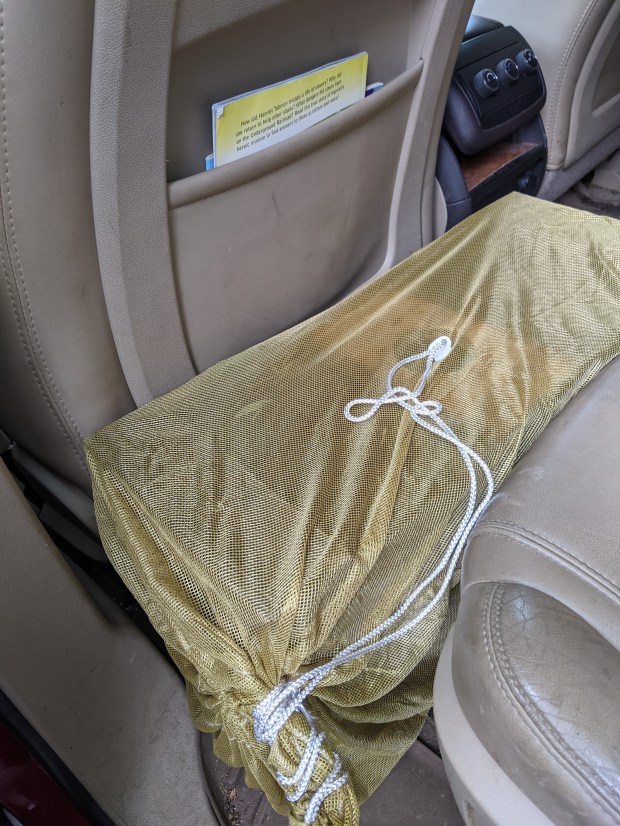
A Nuc (short for nucleus colony) is a small 5 frame group of bees that is comprised of a queen, lots of what are called brood larva, some honey, and many bees to take care of the queen and get you started with a hive.
The other popular method to install a colony of bees is to obtain a package. A package is a box (normally 8 lb’s) of loose bees, a queen that’s in a cage, and a can of syrup for feed.
I brought the nuc home, and my first thoughts were to how heavy the sucker was. You would think a box of bees would be light. after all, they buzz all around. they shouldn’t be that heavy, right? this sucker clocked in at 36.6 pounds.
Installing a Nuc is a pretty straight forward affair,
1. Stup your hive that you want to put the nuc into
2. Make sure your smoker is setup and working
3. Crack the nuc box open, and smoke the bees
4. Slowly and methodically remove the frames one at a time
5. Place the frames in the middle of hive with other frames on the outside
6. Add a food source
7. Install an entrance reducer (makes the opening of the hive very small,
This gives the bees a smaller spot to defend against hostiles
8. Close it up and walk away for a week.
I setup my boxes in a manner that let me peak in this week on the feeder to make sure it had plenty of food, and not disturb the bees. The first week of any install is a honeymoon period, where you don’t want to go open the hive up to see how they are doing. You want to give the bees space to do things like orientation flights, and to start to do what is called drawing out the comb in the hive box. Drawing out comb is where the bees create and add wax to the frames to allow the queen to have chambers to lay in, as well as to place food for the colony.
When you step back and think about it, a hive inspection is a very invasive event. Imagine if you were happy in your house and the roof was lifted off. Then the walls were pulled out and turned all around and put back down. And sometimes a wall squishes one of your family members. It’s no wonder bees get a little feisty during inspections!
So this afternoon, I was able to crack open my hive. I found the following, and I’m documenting here for my own reference/record, and I think it’s fascinating, and I imagine someone else would be interested as well.
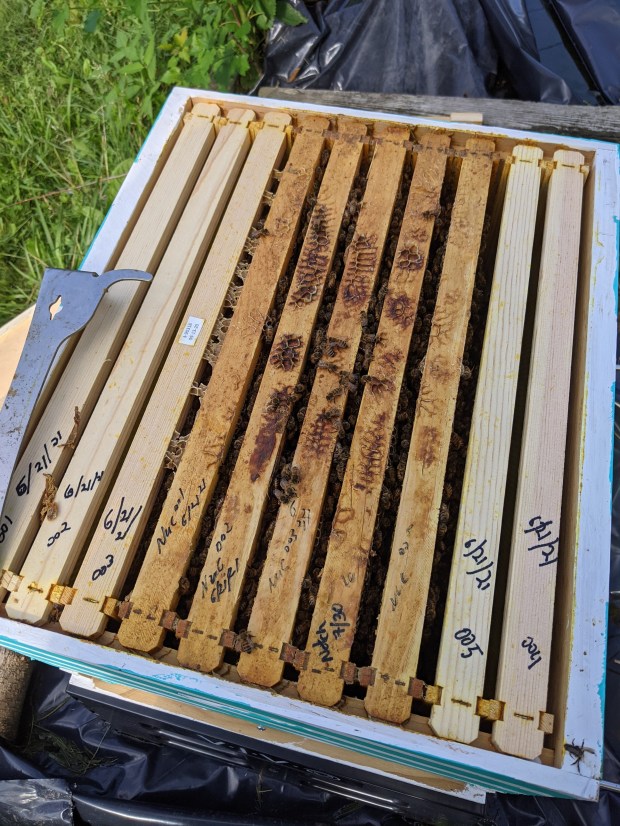
What you see here is the top down view of 10 frames of the hive. the middle 5 that are discolored are the original frames I received with my Nuc. I have labeled each frame and the date of initial install. Frames 005 and 003 each had one side of drawn comb which had, what I believe is either nectar or my sugar water in them. (there was also a small amount of pollen, not nearly as much as I would like to see. I wonder if I need to put some pollen in there.
The queen came up to say Hi to me, she’s in the middle on Nuc 003. I didn’t get a picture of here. (I need to figure out how to take more pictures while having my hands busy with the frames, smoker, and trying not to get propolis all over everything!) The Nuc frames are loaded with capped brood (larva of worker bees that will hatch over the next 21 days), lots of honey stores, and more nectar.
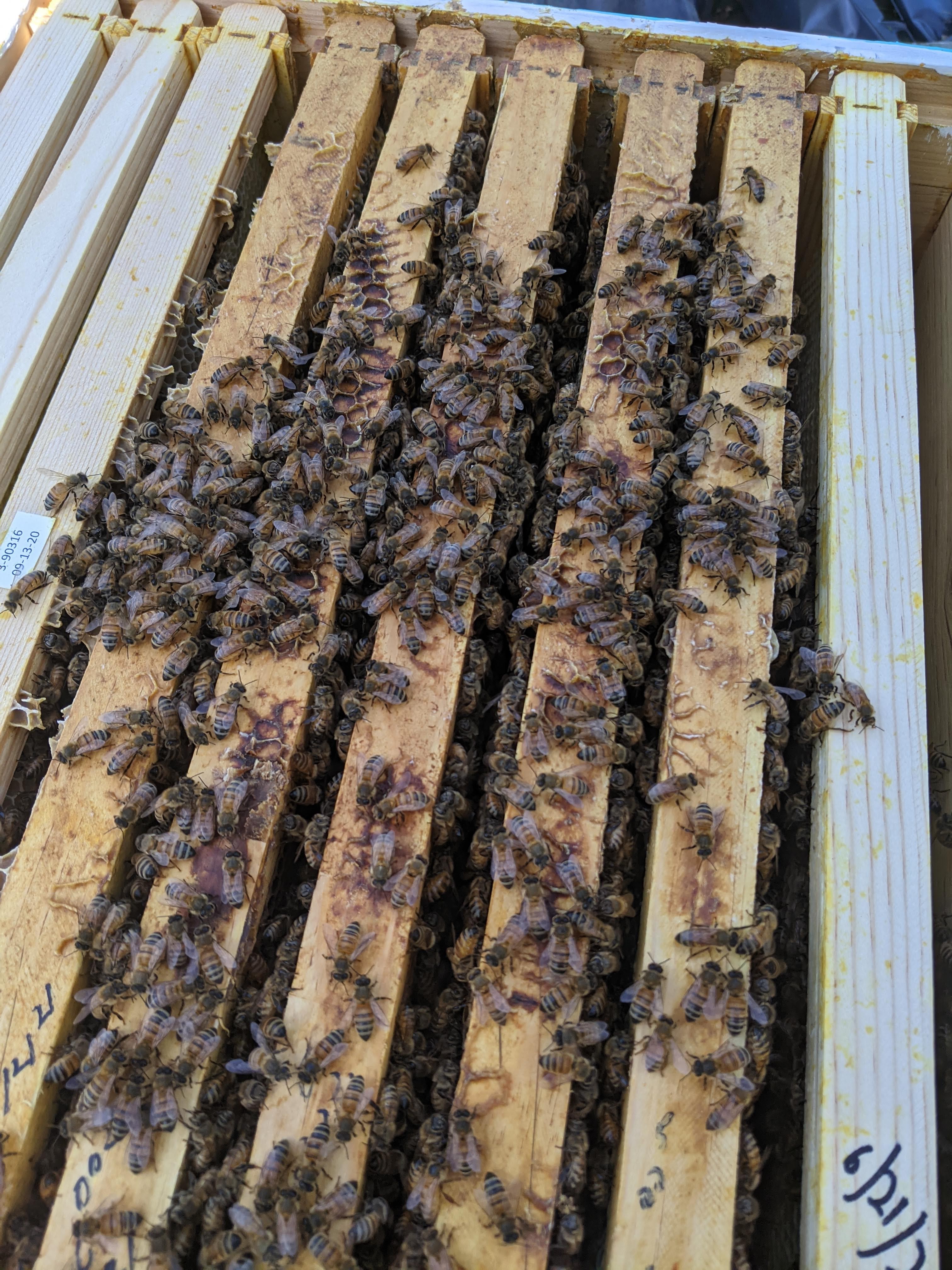
Here are a bunch of the girls…. they came out to see what was going on. These show that they are a good mix of large and smaller bees. That is great, it shows a diversity of the generations in the Nuc, and should set me up to having a solid colony going into winter this year.
Other notes that are interesting: I found what I think is one small hive beetle (pest that can wreck havoc. -it was dispatched.) and my bottom drawer seemed to have a good bit of pollen in it. I am going to keep watching and see if somehow I have an ad-hoc pollen collector. If that’s the case, I can collect and give back to them at a later date.
Finally, an odd behavior I am going to have to ask about was some observed behavior, where I saw a worker bee smack a drone around and push them off a frame when I pulled it up for inspection. this happened twice. interesting, and more things to read up on.
well, this is quite long, but thanks for checking it out!
 Neonpenguin